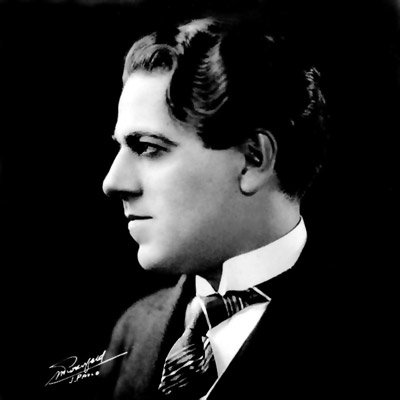
Heitor Villa-Lobos
1887 - 1959
Heitor Villa-Lobos was a Brazilian composer, celebrated for uniting music with natural sounds. He had his first music lessons with his father, Raul Villa-Lobos, an employee of the National Library, who died in 1899. He had taught him to play the cello making do with a viola, because of “Tuhu’s” size (Tuhu was Villa–Lobos indigenous childhood nickname).By himself, he learned the acoustic guitar in…
Heitor Villa-Lobos was a Brazilian composer, celebrated for uniting music with natural sounds. He had his first music lessons with his father, Raul Villa-Lobos, an employee of the National Library, who died in 1899. He had taught him to play the cello making do with a viola, because of “Tuhu’s” size (Tuhu was Villa–Lobos indigenous childhood nickname).By himself, he learned the acoustic guitar in his teens, amid the carioca choro circles, to which he payed tribute in his series of most important pieces: the Choros, written in the 1920s. Her got married in 1913 to the pianist Lucília Guimarães. After his travels to the North, Northeast and Midwest of Brazil, in the late 1910s, he enrolled in the National Institute of Music (currently UFRJ school of music), but did not come to conclude the program, due to maladaptation – and discontent – with academic teaching.His first pieces had some influence of Puccini and Wagner, but Stravinsky’s were more decisive, as shown in the Amazonas and Uirapuru ballets (both from 1917). Despite his pieces having aspects of European writing, Villa-Lobos always infused his pieces with aspects of Brazilian music. He used sounds of the woods, from indigenous and African events, folkloric songs, choros, sambas and many other genres of the country. The Academia despised what he wrote, only until a South American tour of polish pianist Arthur Rubinstein, in 1918, made possible a solid friendship that would open the doors for Villa-Lobos moving to Paris, in 1923.In the Modern Art Week of 1922, an episode became famous in which the composer is called to the stage and enters with a shoe one foot and a sandal on the other, with an eye-catching bandage on his big toe. Interpreted as provocative avant-garde attitude, Villa-Lobos is booed; he later would come to explain that the wound was real, expressing his naivety towards the harsh reactions provoked by the eventHe spent two long seasons in France, the time’s biggest haven for music, through the financial aid of the Guinle family. He resided in Paris between 1923 and 1924, and from 1926 to 1930, when he came back to Brazil to participate in the Getúlio Vargas government’s musical education program. In that time, Stravinsky’s influence was overwhelmed by the Brazilian music’s, be it indigenous or choro. These two aspects are very noticeable in the fourteen choros. Northeastern themes would come to be more present in the 1930s, alongside the inspiration found in Bach.The year of 1930 gave a new direction to the composer’s life, because he was able to concretize his project of introducing choral singing in high schools across the country, made possible by the trust invested in him by the state of São Paulo’s intervener, João Alberto, ally of Getúlio Vargas. Villa-Lobos became a full professor of choral singing in Rio de Janeiro’s Pedro II school.From this project, stood out the open-air concerts with the participation of thousands of students. One of these concerts, in São Januário Stadium, had forty thousand voices and the presence of president Getúlio Vargas. In 1936, he separated from his first wife and united with Arminda d’Almeida Neves, “Mindinha”, with whom he lived with until his death.In the 1940s, Villa-Lobos met the United States. He had great acceptance of his work and definitive acclaim. Several American orchestras ordered new compositions from him, as well as renowned musicians that lived or performed there. If half his life had been on a Rio-Paris axis, now it would become Rio-New York.Even with the success, he was never rich; also didn’t have any children. In 1947, in New York, he suffered his first surgical intervention to deal with the issue that would take his life twelve years later, little mentioned in his biographies: Bladder cancer, probably caused by his addiction to cigars. He recovered and gained more energy to compose.In his last decade of life he composed his last five symphonies, his last six string quartets, almost all his concertos (except the first one for piano and the first for cello), his opera Yerma, the A Floresta do Amazonas suite and several chamber pieces, such as Fantasia Concertante for Cellos (1958) and the Instrumental Quintet, for the flute, violin, viola, cello and harp (1957). In a new trip to Paris, in 1955, he recorded some of his most important pieces, conducting the ORTF (French Radio-Broadcasting Orchestra), over seven hours of music remastered in the 1990s, and currently available in CD. In 1959 he conducted his last recording, with the Sympohny of Air, precisely the Floresta do Amazonas, then returned to Rio de Janeiro, where he came to pass away months later, in his home.Villa-Lobos was greatly annoyed by the title of Brazilian composer. He always made sure to say he was a composer of the world, after all, nobody refers to other composers like Mozart, Bach, etc., explicating the countries they are from.Among the most important titles he received is the one of Honorary Doctor by the University of New York; was the first president of the Brazilian Academy of Music, conducted eleven Brazilian orchestras and almost seventy in Argentina, Austria, Belgium, Canada, Chile, Cuba, Denmark, England, Finland, France, Germany, Greece, Israel, Italy, Mexico, Netherlands, Portugal, Spain, Switzerland, USA, Uruguay and Venezuela.Villa-Lobos’s music is, above all, sui generis: The composer never came to possess a defined genre. If even that, it is possible to find preferences for some stylistic resources: Unusual combinations of instruments (that many times jeopardized the music’s expressivity) strong bow strokes, use of popular percussion, imitation of bird songs (resource in which he excelled, only having one contender, the frech Olivier Messiaen; they never met).He did not defend nor fit in any movement, and remained for a long time unknown from the public in Brazil, and mercilessly attacked by the critics, among them, Oscar Guanabarino, his lifelong nemesis. Still, he was always loyal to his own inner impulse to compose; “My music is natural, like a waterfall”, said one time. This loyalty to his instinct made him the most prolific erudite composer of the XX century; only certain baroques, such as Telemann, possess more pieces than Villa-LobosThis instinct, because of the word’s very nature, was not disciplined, and that indiscipline has manifested many times in an excessively free harmony (use of chords), when writing a deliberately tonal piece, and in a inadequate orchestration – His unscheduled life, sometimes having to surrender to the day-to-day necessities – collaborated for several of his pieces not having a better finishing.Villa-Lobos, though, always refused to make revisions, accepted his “monsters”, as he called the rough drafts he wrote on napkins, and never used the word “finishing”: He did not focus on a single piece, and soon passed to the new ideas that came to him, in his living room, in a ship or a train. On the other hand, it is possible to find compositions where melodies used once before recuured, such as in Magdalena.These problems, although, are not present in three of his most well known pieces. O Trenzinho do Caipira is a masterful sample of the use of the orchestra’s instruments reproducing the sound of a train. The Cantilena from the Bachianas nº 5, very original in its instrumentation, possesses a simple counterpoint, but very correct. The introduction from Bachianas n° 4 – Starting material for Baden Pwell and Vinicius de Moraes’s Samba em Prelúdio – presents well crafted harmonic progressions that perfectly marry the romantic climax halfway through the movement.source: www.letras.com.br
Leia mais
Birth: Brazil Rio de Janeiro
RJ,
5/3/1887
Death: Brazil Rio de Janeiro RJ, 17/11/1959
Wikidata
VIAF
ISNI